There's a myth that sits on top of game development like a wet blanket: that you have to be an artist to make a game worth playing. It stops a lot of people before they start. They can code, or they can design, or they just have a good idea and the patience to build it, but they can't draw a convincing tree, so they decide the whole thing is off the table.
It isn't. Some of the best-looking games on your shelf were built by people who never drew a single asset. They didn't cheat, and they didn't hire out everything. They did something more useful: they got good at assembling rather than creating, and they picked projects that didn't need them to be an artist in the first place.
Here's how you do the same.
Separate "making art" from "having good art"
The first thing to untangle is that these are two different skills, and only one of them is optional.
Making art is drawing, sculpting, animating, painting textures by hand. That takes years, and if it's not where your interest lies, that's fine. Having good art in your game is a different job. It's about consistency, mood, and direction. It's curation. And curation is a skill you can learn in an afternoon and get genuinely good at in a month.
A game that pulls fifty assets from one coherent source and lights them well will look better than a game with brilliant, hand-made assets that don't agree with each other. Players don't grade your art on how it was made. They react to whether it feels like one world. That feeling comes from consistency, not craftsmanship, and consistency is something you can engineer without drawing anything.
Start with a pile of good assets
The raw material is out there, most of it free. Sites like Kenney, Poly Haven, OpenGameArt and itch.io publish enormous libraries of models, textures, sprites and audio, a lot of it under CC0, which means you can use it, modify it, and ship it commercially with no strings attached.
Before you download half the internet, a word on the thing that trips people up: licences. "Free" covers a range of terms. CC0 is do-what-you-like. CC-BY wants a credit. Some packs are non-commercial only, some marketplace assets can go in a game but not be resold, and a few have oddly specific rules buried in a readme. None of this is hard, but it does need tracking, because the day you decide to sell your game is the wrong day to discover one texture was never cleared for it. Note the licence on every asset as it comes in, not later.
The goal at this stage isn't to find the asset. It's to build a working palette: a handful of sources whose style you can live with, that share enough of a look to sit together, or that you're willing to push into agreement. Which brings us to the actual work.
Modify, don't just drop in
The reason asset-pack games get a bad reputation is that people use them raw. They grab the popular free pack, drop it in untouched, and ship a game that looks exactly like the other four hundred games built from the same pack. The pack isn't the problem. Using it unchanged is.
You don't need to be an artist to modify assets. You need to be willing to change a few knobs:
- Recolour and re-texture. A model is just a shape until you decide what it's made of. Take a plain crate, a rock, a wall, and swap the material or texture for a different one, and it becomes a new object. Do this consistently across a scene, pulling everything toward one palette, and a dozen mismatched packs start to look like they were made for each other. This is the single highest-leverage thing a non-artist can do.
- Rescale and recombine. Kitbashing, in the trade. Take parts from different models and assemble them into something that isn't in any pack. A building from three modular kits. A creature from two. Nobody can point at the source because the source is four sources.
- Retone the whole thing. Even leaving geometry alone, shifting the colour balance of an entire set of assets toward warm, or cold, or desaturated, immediately makes them feel authored rather than borrowed.
The point of all this is deniability, in the good sense. You want the finished thing to look like your game, not like a shopping list. A modest amount of modification gets you most of the way there.
Let lighting and post-processing do the heavy lifting
If curation is the cheapest way to look like you have art direction, lighting is the cheapest way to have it.
The same grey untextured scene can look like a horror game, a sunny platformer, or a moody puzzle box depending entirely on how it's lit. Lighting is not drawing. It's placing a few lights, choosing a colour temperature, and deciding where the shadows fall. Modern engines hand you global illumination, soft shadows and physically based lighting essentially for free. Spend an afternoon learning your engine's lighting system and you'll get more visual return than a week of trying to learn to paint.
Then stack post-processing on top. A colour-grading pass to lock in a mood. A little bloom so lights feel like lights. A vignette to pull the eye inward. A touch of grain or a subtle chromatic aberration if it suits the tone. Individually these are sliders. Together they're the difference between "some assets in a scene" and "a look". Most of what people call style in a modern game is a lighting choice and a post-processing stack sitting on top of assets the developer bought.
None of this asks you to draw. It asks you to make decisions and be consistent about them, which is exactly the kind of thing a systems-minded developer is already good at.
Choose a game that doesn't need you to be an artist
The smartest move of all comes before any of this: pick a project whose fun doesn't live in the visuals.
Some genres are art-hungry. A hand-animated 2D adventure or a character-driven action game will fight you every step of the way if you can't draw. Others barely care what they look like, as long as they look clean, because the enjoyment is somewhere else entirely:
- Puzzle games. The satisfaction is in the mechanic. A clean, minimal look isn't a compromise, it's often the correct choice. Tetris didn't need a concept artist.
- Deck-builders and card games. Systems, numbers, and clever interactions carry these. You need readable cards and a tidy layout, not a portfolio.
- Strategy, management and simulation. Icons, tidy UI, and legible information beat lavish art. Players stare at spreadsheets dressed as cities and love it.
- Narrative and text-driven games. Words do the work. A strong visual frame and good typography go a long way, and neither requires drawing.
- Abstract and minimalist games. Geometric shapes, bold colour, and motion. An entire aesthetic built out of primitives, which happens to be exactly what a non-artist can produce.
Picking one of these isn't settling. It's playing to your strengths. A great puzzle game built by someone who can't draw will always beat an ambitious action game abandoned because its creator couldn't produce the art it demanded.
The bit nobody tells you: it's a curation problem
Once you go down this road, you discover the real bottleneck isn't making things. It's finding things. You end up with folders of packs from a dozen sources, hundreds of textures, half of them nearly identical, and no memory of which crate went with which wall or which licence let you ship which rock.
This is the boring, unglamorous work that sits underneath every asset-driven game, and it's the thing that quietly kills momentum. You didn't get into this to spend your evenings archaeologising your own Downloads folder. A game built from assets lives or dies on whether you can actually find the right asset when you need it, see it next to the others to check they agree, and trust that its licence is cleared.
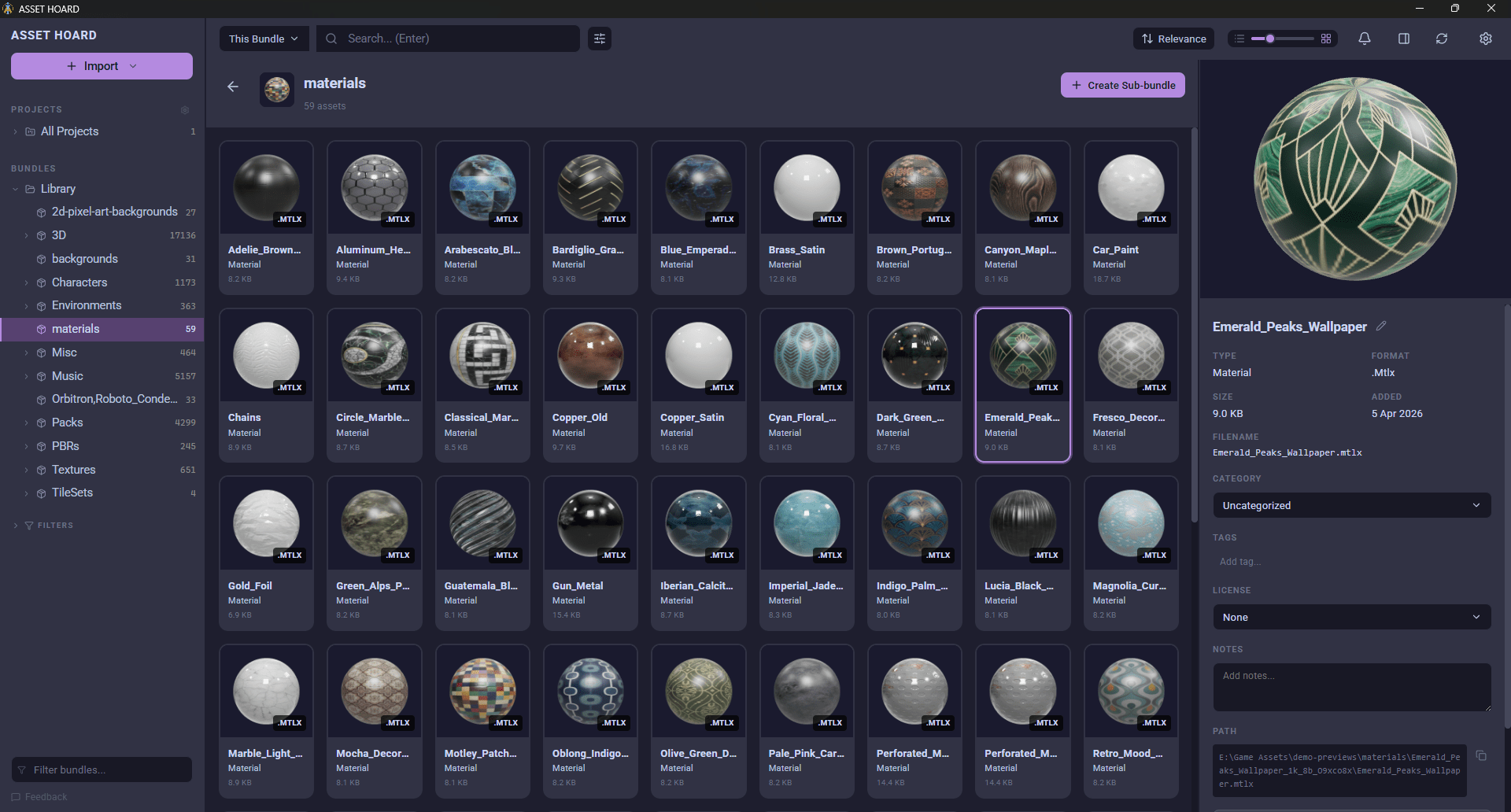
That's the whole reason AssetHoard exists. It's an offline, local-first library for exactly this: everything you've collected in one place, previewable side by side so you can build a consistent palette by eye, tagged so you can find it, with the licence recorded on every single asset so shipping day holds no surprises. The making-a-game part is yours. The keeping-track-of-your-ingredients part is ours.
You were never blocked by not being able to draw
If you take one thing from this: the barrier you thought was there mostly isn't. Not being able to draw stops you from being a concept artist. It doesn't stop you from being a game developer.
Get a good pile of assets. Modify them enough to make them yours. Light them well and grade them into a mood. Pick a game where the fun lives in the design, not the pixels. And keep your ingredients organised enough that building stays fun instead of turning into filing.
The art will be fine. Go make the game.
The AssetHoard Team
Frequently asked questions
Yes. Plenty of successful games are built almost entirely from bought or free asset packs, with the developer never drawing a thing. The skill isn't drawing, it's curating: picking assets that share a consistent style, tying them together with lighting and post-processing, and choosing a genre that leans on systems and design rather than bespoke art.
Usually yes, but it depends on the licence. Most marketplace and CC0 assets allow commercial use, sometimes with an attribution requirement. The two things that catch people out are assets licensed for non-commercial use only, and using an entire pre-made pack so unchanged that your game looks like everyone else's. Read the licence before you ship, and modify enough that the pack becomes yours.
Change the surface, not just the mesh. Recolour and swap textures so packs from different sources share a palette, apply a consistent lighting setup, and add a post-processing stack (colour grading, bloom, vignette, a touch of grain). A unified look across mismatched assets reads as 'a style', which is most of what people mean by 'good art direction'.
Games where the fun lives in systems rather than visuals. Puzzle games, deck-builders, strategy and management sims, text-driven and narrative games, and anything with a deliberately minimal or abstract look. These lean on design, code, and audio, all of which you can learn without ever picking up a stylus.