Open your subscriptions page. Go on. Add it up.
Most creatives I know are paying for at least a dozen recurring services before they've even started their actual work. Design tool, file storage, music streaming, project management, note-taking, email, a couple of streaming services they forgot to cancel, two AI assistants, a font library, a stock asset site, and somewhere in there a "productivity" app that emails them weekly to remind them they're still being charged.
None of it is really yours. You're renting the lot.
Why we swapped owning software for subscriptions
There used to be a simple deal. You'd hand over some money, get a box (or a download, eventually), and the software was yours. Forever. The company could release a new version next year and you could ignore it. Your files were files. They opened with the program you bought, on the computer you owned, whether or not the company that made it still existed.
That model didn't disappear because users wanted it gone. It disappeared because the people selling software realised they could make more money the other way. Recurring revenue is more predictable. It's easier to forecast, easier to value, easier to raise money against. A one-time purchase asks the company to keep earning your business. A subscription assumes you'll forget to cancel.
So everything became a subscription. Tools that used to cost $50 once now cost $20 a month. Add it up over five years and you've paid twenty-four times as much for the same thing, plus whatever features they've quietly moved behind the next pricing tier in the meantime.
The maths is bad. The ownership maths is worse.
If subscriptions were just expensive, that would be one thing. You could argue the convenience is worth it, or that ongoing updates justify the price. Sometimes that's even true.
The bigger problem is what happens to your stuff when the relationship ends.
Stop paying and you don't downgrade to the version you used to own. You lose access entirely. Your files are still technically yours, in the sense that they exist somewhere, but the app you used to open them is locked behind a paywall. Your project files become hostages.
Worse, a lot of "your" data isn't actually on your machine. It lives on the company's servers. Your tags, your collections, your project history, your settings, your assets. The day they pivot, get acquired, shut down, or decide your use case isn't profitable enough to support anymore, all of that work evaporates. You get a courtesy email and a 30-day window to export what you can. The metadata you spent years building, the organisation, the structure: gone.
This isn't a hypothetical. It's happened to users of dozens of creative tools in the last decade. The pattern is the same every time. Beloved tool gets acquired. Pricing changes. Features get removed. Eventually the lights go out. The CEO writes a blog post thanking you for the journey. Your data is yours to retrieve, mostly, sort of, with some asterisks.
Subscriptions also make every tool worse
There's a quieter problem with the subscription model that doesn't get talked about enough: it changes what the software is for.
When you pay once, the software's job is to be good enough that you'd recommend it. The company makes money by making something people want to buy. The incentive is to ship a great product and move on.
When you pay every month, the software's job is to keep you paying. The company makes money by making it harder to leave. That changes everything. Features get tied to the latest version, which is tied to the subscription. Export formats get worse, or proprietary. Cloud sync becomes mandatory so you can't take your data and run. The login screen appears earlier. The "cancel" button gets harder to find.
Some of this is malicious. Most of it isn't. It's just what happens when the incentive shifts from "build something good" to "keep them subscribed". Even good people, building good software, drift in that direction over time.
"But it's just a few dollars a month"
It is. Until it isn't.
The few dollars become more dollars at the next round of price increases. The features you depend on get moved to the next tier. The plan you signed up for gets renamed and what was included before now costs extra. Free tiers shrink. Trial periods shorten. The yearly plan that was a discount becomes the only way to get the features you used to have on monthly.
And it's not one subscription. It's twenty. Each one a "small" recurring fee. Together they're a second rent.
For indie developers, who are already juggling engine licences, hosting, asset store purchases, music tools, marketplaces, store fees, and tax, another subscription isn't a small ask. It's another thing to track, another auto-renewal to forget about, another vendor with a copy of your credit card.
Local-first means it's yours
The alternative is straightforward, and it used to be the default. Software that runs on your machine. Files that live on your disk. A licence you bought, not rented. A tool that keeps working whether or not the company is having a good quarter. It is the thinking behind every offline, local-first asset manager worth using.
The difference comes down to a handful of things you feel every day:
| Subscription cloud app | Local-first, one-time purchase | |
|---|---|---|
| Cost over time | Recurring, and rising with every price increase | Paid once, no ongoing fee |
| Where your files live | On the company's servers | On your own drive |
| If the company shuts down | Access ends, with a deadline to export | The app keeps running, your library stays |
| Account required | Yes, a login and a profile on their servers | None, nothing to log in to |
| Who controls updates | The vendor, tied to your subscription | You decide when, or whether, to update |
That's how AssetHoard works.
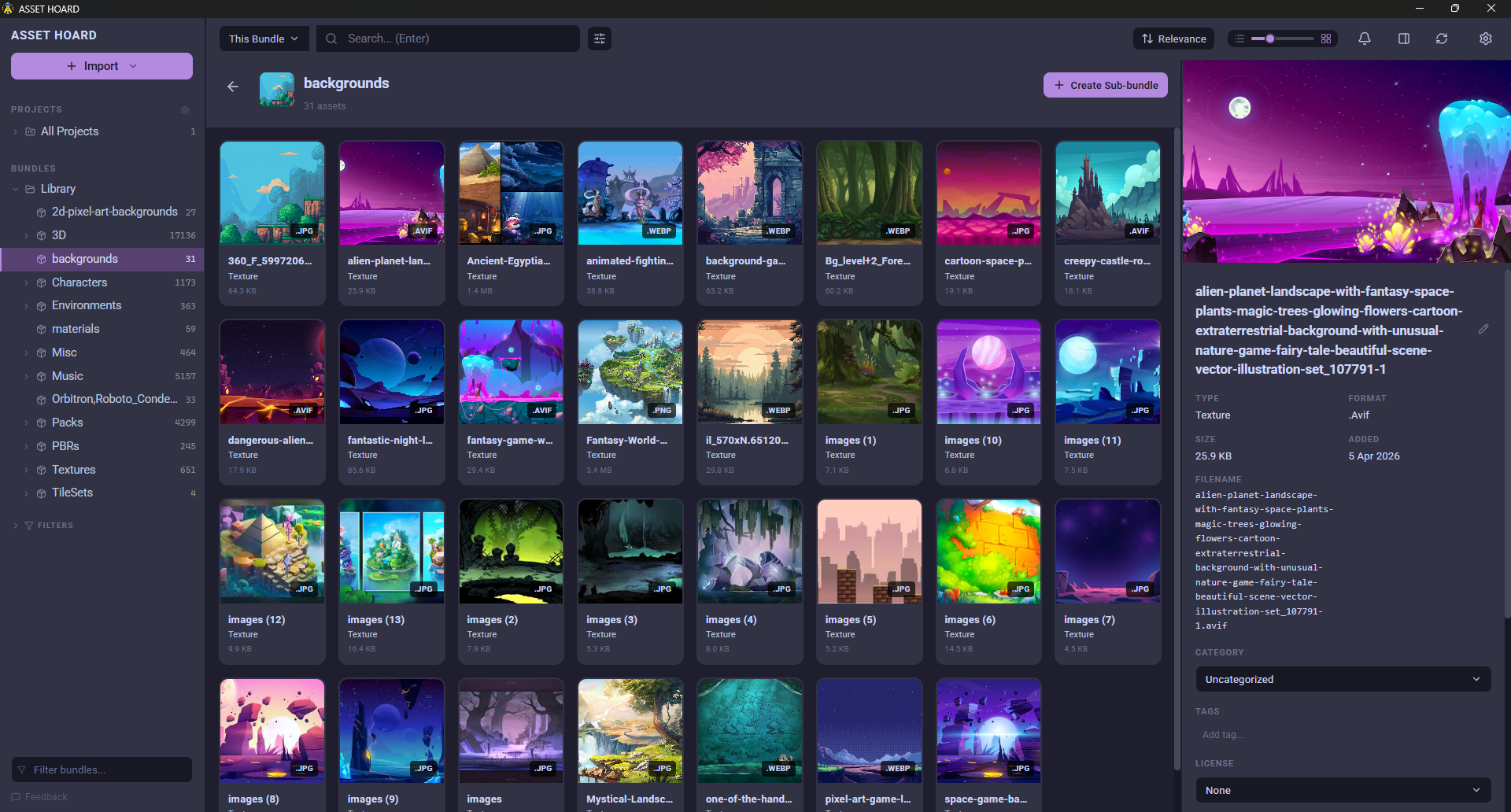
You pay once. You get the app. It runs on your computer. Your asset library is on your drive, not on our server. Your tags, your collections, your previews, your metadata, right down to the licence on each asset: all local. The catalogue file is yours. You can back it up, copy it to another machine, archive it on an external drive, hand it to your future self in ten years.
If we vanish tomorrow, your library doesn't. The app keeps running. Your files keep opening. The work you've put into organising your assets stays with you, because it's on your machine, in formats you can read, with no cloud dependency to lose.
We don't have a recurring billing system because we don't want one. We don't have an account system because you don't need one. There's no "your plan includes" because everyone's plan is the same: you bought it, it's yours.
What to expect from software you actually own
You shouldn't have to think this hard about whether a piece of software will exist next year. You shouldn't have to read a privacy policy to find out who owns your files. You shouldn't have to keep a spreadsheet of every recurring charge so you can remember what you're paying for.
The bar for software ownership used to be lower because the deal was simpler. Buying meant owning. Owning meant keeping. Keeping meant having control over your own work.
It can still be like that. It just takes choosing tools that are built on that assumption, and being willing to walk past the ones that aren't.
AssetHoard is one of those tools. There are others. Look for them.
The AssetHoard Team
Frequently asked questions
No. AssetHoard is a one-time purchase. You pay once, you own the app, and it keeps working whether or not we release another version or stay in business. There is no recurring fee and no plan to upgrade to, because everyone's plan is the same: you bought it, so it is yours.
Your library stays exactly where it is, on your own drive. AssetHoard is local-first, so your assets, tags, collections and metadata live on your machine rather than on our servers. If we disappeared tomorrow the app would keep running and your files would keep opening, with no cloud dependency to lose.
No. Your asset library and its catalogue file are stored locally on your computer, not on an AssetHoard server. You can back the catalogue up, copy it to another machine, or archive it on an external drive, because it is a file that belongs to you.
No. AssetHoard has no account system because it does not need one. There is nothing to log in to, no password to manage, and no profile sitting on our servers. You bought the app, so it is simply yours to run.